
Why Anxious and Avoidant People Are Drawn to Each Other (And Why It Feels So Intense)
Why The Anxious-Avoidant Cycle Feels Really Good At First
At first, it feels really good.
You notice you’re thinking about them more than you expected to. You check your phone to see if they’ve texted. And when they do, it feels good in a way that’s hard to explain, even if it’s just something small. There’s something about them that stands out.
They’re not overly available. They’re a little harder to read. And instead of that turning you off, it makes you more interested. You find yourself paying more attention, wondering what they’re thinking, wanting to understand them.
It feels like chemistry. Like there’s a spark there right away, something that makes this feel different from other connections you’ve had.
And it doesn’t feel overwhelming yet.
It feels like a connection without too much pressure. Like you can be in it without everything feeling high-stakes.
But at the same time, there’s a pull. You care a little more than you expected to this early on. You want it to go somewhere. You want them to choose you. And in the beginning, that all just feels like a good thing. It’s new, exciting, exhilarating, unpredictable, and yet maybe… familiar.
Then Something Starts to Shift
And then, at some point, something starts to shift.
It’s not always obvious at first. There’s no fight or explicit blow-up, no argument and no clear moment you can point to. Nothing that would even make sense to explain if someone asked what changed.
But you feel it.
Replies get a little slower. Plans don’t feel as solid. The energy is just slightly different, and you notice it even if you can’t fully explain it. You start paying attention in a different way. Not the good kind, the kind where you’re looking for clues.
What used to feel like butterflies in your stomach starts to feel more like dread, anxiety, and worry.
You’re still thinking about them constantly, but it’s not the same kind of thinking. You’re replaying things. Wondering what changed. Trying to figure out if you said something, did something, came on too strong, or not enough. Trying to solve something you can’t even fully name yet.
And on the other side of it, something is shifting too, just in a different way.
The closeness that felt exciting starts to feel like weight. Like there are expectations now that weren’t there before. Like showing up fully in this relationship requires something that feels risky to give. It’s not that they don’t care. It’s that caring this much starts to feel like a lot to hold.
So there’s this pull to create some space. Not a conversation about it. Not an explanation. Just… less. A little less available. A little less present. Hoping some distance makes it feel more manageable.
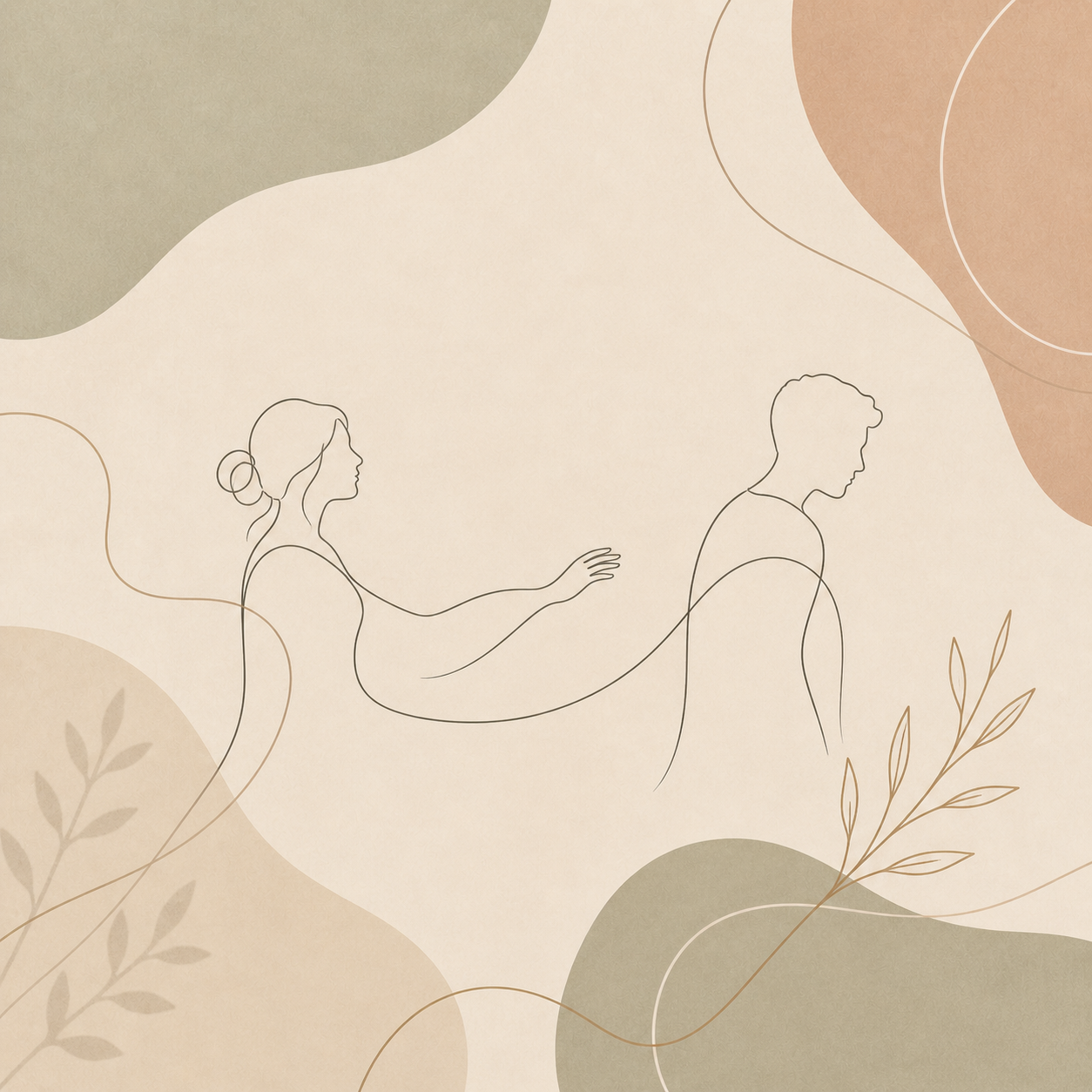
Now one person is moving closer and one person is moving away. And neither of them is doing it to hurt the other. They're both just reacting to the same shift, from completely different places, in completely different ways. And more often than not, nobody's saying any of that out loud.
That’s usually where it starts to get hard.
Why You’re Drawn to Each Other
There’s usually something about each other that just… fits in a way that feels familiar, even if it doesn’t feel good later on.
If you tend to lean more anxious, you might find yourself drawn to people who feel a little harder to fully reach. There’s this pull to get closer, to understand them, to feel chosen by them in a way that really sticks.
And if you lean more avoidant, being with someone who wants closeness can feel good at first, too. It can feel affirming to be wanted, without having to fully give up your space right away.
So both people are getting something that makes sense to them, at least in the beginning.
It just doesn’t stay that way. Because what feels good in the beginning doesn’t stay balanced. It starts to pull in opposite directions.
The more one person moves closer, the more the other starts to need space. And that’s where the dynamic really begins.
Why It Becomes So Intense
Once that shift happens, it doesn't stay small for long.
The more you feel that distance, the harder it is to just sit with it. So you reach a little more. You check in more. You replay the good moments and try to figure out how to get back there. You're not planning it or calculating it. It just feels like something is wrong and you want to fix it. You want to understand it. You want to feel close again.
And they feel that. But it doesn't land the way you mean it.
For them, it starts to feel like pressure. Like there's something being asked of them that they don't know how to give, or aren't sure they're ready to give. And even if they care about you, even if they want to show up, something in them needs to step back. So they do. Not in a way you can easily point to or call out. Just quieter. A little less there. And you feel that too.
So you reach a little more. And they pull back a little more. And you're not doing it to hurt them, and they're not doing it to hurt you. You're both just responding to how it feels, in the only way that makes sense in the moment.
But it keeps going. And instead of settling, it starts to feel more intense. More consuming. Like the stakes keep getting higher the longer it goes on.
Because at some point it stops feeling like two people figuring something out and whether or not you like each other, it starts to feel like something you could lose, or something you can never quite fully have. And that combination, that push and pull, is what makes it so hard to just let it be, or walk away from it.
Why It’s So Hard To Leave
It's not that you don't know something is off. You probably do. You've maybe known for a while. But knowing doesn't make it easier to walk away. Because it's not just about whether it's working. It's about what it feels like when it is working. And when it is, it feels like something you haven't felt with a lot of people. That part stays with you.
So you hold onto the moments where it felt right. Where they were fully there. Where it felt like exactly what you'd been looking for. And some part of you believes that version of things is still possible. You just haven't found the right way back to it yet.
You give a little more space. You reach out a little less. You wonder if you're too much, or not enough, and you quietly adjust. Not because something is wrong with you. Because you care, and you're trying.
And then there are moments where it does come back. Even briefly. And that's enough to reset everything.
That's what makes it so hard to leave. Not the hard moments. The good ones. The almost. The feeling that you were so close, and maybe still are.
And underneath all of it, there are two people who are scared, just of completely different things. One of you is afraid of losing the relationship. The other is afraid of what it means to fully let someone in. And because neither of those things ever really gets said out loud, they just quietly shape everything.
That's not a flaw. That's what this pattern does. And it's exactly the kind of thing that starts to make more sense when you have the right support.
What Starts To Change When You Have Support
What starts to change isn’t that you stop feeling any of this, or that the same situations don’t come up anymore.
You still notice when something feels off. You still feel that pull to get closer when someone pulls away, or that instinct to create distance when things start to feel like too much. That part doesn’t just disappear.
But you stop moving into it the same way.
You're not trying as hard to get back to how it felt in the beginning or beating yourself up for where things are at. You're not adjusting yourself as quickly, or shrinking as fast, just to keep things from slipping. There's a little more space between what you feel and what you do next. And that space, as small as it sounds, is actually where things start to change.
Because when you're not responding the same way, the pattern can't keep playing out the same way. It needs both parts to keep going. When your part starts to shift, even slightly, the whole dynamic has to move with it.
You start to see what's actually happening instead of just reacting to it. What you're actually feeling versus what you're afraid is happening. Those two things can feel identical when you're in it. They start to feel different.
And over time, that changes what you're drawn to. What feels like a real connection and what just feels familiar start to become easier to tell apart. What you're willing to keep adjusting yourself for starts to feel clearer, too.
It's not a dramatic shift. It doesn't happen all at once. But it's real. And it's usually quieter and steadier than people expect it to be.
This is the kind of thing that can be hard to untangle on your own. Not because something is wrong with you, but because you've been inside of it for a long time - it’s hard to see the forest from the trees. Having a space in therapy to look at it clearly, without judgment, and without having to manage anyone else’s reaction while you do, can start to shift how all of this shows up.