Reading, subscribing to this email list, or interacting with this content does not create a therapist-client relationship between you and Beneath The Pattern LLC and/or Bailey Taylor, LCPC, LPC. Because every individual's needs are unique, you should always seek the advice of your own licensed mental health provider or primary care physician regarding any questions you have about a mental health or medical condition.

By subscribing to this list or using this information, you agree that Beneath The Pattern LLC and/or Bailey Taylor LCPC, LPC, is not responsible or liable for any claim, loss, or damage resulting from your use or reliance on any information provided.

Bailey Taylor Bailey Taylor

When Being Good With People Is Actually Something Else

Some people learn to read the room because they're naturally empathetic. Some learned because getting it wrong felt costly. This is about the difference, and what it costs to always be the easy one.
Abstract minimalist illustration in warm neutral tones showing a woman surrounded by fragmented faces and flowing lines, symbolizing hyper-attunement, people-pleasing, emotional masking, and loss of self in relationships.

There's a pattern that shows up in people with late-diagnosed ADHD, in eldest daughters, in people who grew up in emotionally unpredictable environments. It looks like emotional intelligence from the outside. From the inside, it feels like never being fully off.

People have probably described you as thoughtful, emotionally intelligent, easy to be around, or "good with people" for most of your life. You notice when someone's tone shifts before they've finished the sentence. You can feel tension enter a room before anyone has named it out loud. And without really deciding to, you adjust — soften, smooth, make sure everyone is okay — before you've checked whether you are.

Those things are, in many ways, genuinely true. The empathy is real. The care is real.

But for some people, especially those who grew up feeling responsible for others' emotions, moods, or stability, being "good with people" can slowly become more than just a matter of personality. Because sometimes what gets praised as emotional intelligence is also something else underneath it.

When Keeping the Peace Becomes a Survival Role

There's a particular kind of person who gets very good at reading what a room needs and quietly providing it. At helping, mediating, absorbing, holding things steady. They become the family glue. The one who sat with a parent while they vented about the other parent. The sibling who held things together while everyone else fell apart. The child who learned, somewhere along the way, that adding to the weight of the room wasn't an option.

A lot of these people grew up in environments where keeping the peace didn't feel optional. Where someone's mood could shift the entire temperature of the house before breakfast. Where being observant wasn't a personality trait. It was how you stayed safe relationally.

So you got good at reading people quickly. At softening yourself before anyone asked you to. You figured out where things were heading and adjusted before they got there. Because you'd learned that other people's emotional states could become your problem fast, and that not managing them carefully enough had consequences. Conflict. Distance. The quiet but persistent message that you were too difficult, too emotional, too much.

And so you became someone who monitors carefully. Who makes it easier before anyone has to ask.

Over time that role gets reinforced constantly. People call you thoughtful, emotionally intelligent, easy to be around. They rely on you, lean on you, love you for it. And that part is real too. Which is exactly what makes it so hard to look at directly.


When Empathy and People-Pleasing Start to Look the Same

The disorienting thing about this pattern is that it genuinely doesn't feel like one. It feels like kindness. Like caring about people. Like just being someone who pays attention. And that's not wrong. Those things can be true at the same time as everything else that's also happening.

But a lot of people start noticing, usually in therapy or in moments of exhaustion they can't quite explain, that some of what they've always called empathy is also tied to something that looks more like fear. Not dramatic fear. Just the low-level kind that hums in the background. The awareness that disappointing someone feels disproportionately heavy, that conflict costs more than it seems to for other people, that being "too much" is a thing you actively try not to become.

So the self-monitoring becomes automatic. You over-explain before anyone has had the chance to misunderstand you. Your own feelings get quietly set aside, not because they don't exist, but because someone else's situation always seems to warrant more space. When a relationship feels tense, the first question is what you did wrong, not whether something was done to you. And what you actually want in a given moment can be genuinely hard to access when the louder question has always been what everyone else needs first.

For people with ADHD (particularly inattentive-type ADHD or those diagnosed later in life) and the rejection sensitivity that often comes with it, this gets more layered. When being misread, criticized, or rejected feels especially painful, you develop a kind of preemptive social awareness. Before anyone has signaled that something is off, you're already adjusting. The masking and the people-pleasing end up feeding each other in ways that become genuinely hard to untangle.

For people with histories of parentification, traumatic childhoods, emotional unpredictability, or relational instability, that hyper-awareness doesn't stay a coping strategy. It gets woven into how they understand themselves. It stops feeling like something they do and starts feeling like something they are.

At some point, the question shifts. Instead of "What do I feel?" you find yourself living inside the question "What version of me keeps this relationship safe?" And not even noticing that the shift happened.


The Cost of Over-functioning for Everyone Except Yourself

These patterns are hard to question in part because they work. You do become someone people trust, lean on, turn to. You become genuinely skilled at reading emotional undercurrents and navigating them carefully. That's real. That's not nothing.

But a lot of people hit a wall eventually. A specific kind of exhaustion that's hard to explain, where they realize they've gotten very good at caring for everyone except themselves.

Accepting help feels uncomfortable in a way that's hard to articulate. Trusting your own read on a situation is harder than it should be. Figuring out what you actually want, separate from what would keep everyone else okay, can feel almost foreign. And disappointing someone, even in a small and completely reasonable way, produces guilt that seems wildly out of proportion to what actually happened.

Underneath all of it is usually a quieter fear: if I stop being this version of myself, who am I?

Because at a certain point, these patterns stop being behaviors and start being your identity. A role you didn’t ask for but had to take on, and got very good at it. The caretaker. The reliable one. The person who holds things together. And when you start to shift, when you begin taking up a little more space, saying no to things, becoming less immediately available, the people who got used to the older version of you don't always respond the way you'd hope. Sometimes they push back. Sometimes they get hurt in ways that feel familiar and that trigger the old fear all over again.

And then your internal dialogue looks like: “See? This is why I shouldn't have needs.”


What Happens When You Stop Over-functioning

One of the more painful things to sit with is realizing that you were not always loved only for who you were. You were also rewarded, sometimes very consistently, for how easy you were. For how little you asked for. For how reliably you showed up for everyone else.

And that's a genuinely complicated thing to grieve.

Healing here isn't about becoming cold or indifferent or suddenly putting yourself first in some dramatic way. It's slower and quieter than that. It usually starts with just noticing. Catching yourself softening mid-sentence before anyone asked you to, checking someone's face while you're still talking to make sure you're still okay with them, adjusting the version of yourself you brought into the room before you've even fully arrived.

That noticing creates a little space. And the space is where things actually start to shift.

There is real grief in this process for a lot of people. Grief over how early the monitoring started. Over how much of themselves went quiet inside relationships over the years. Over the fact that the version of them that got the most praise was often the one that cost the most to sustain.

But something also becomes possible on the other side of that grief. Not a transformation. Just a slow change in the question you're living inside of.

From: “How do I keep everyone else okay?”

To: “What would it feel like to stop disappearing inside relationships?”

That second question doesn't have a clean answer. But it's usually where things start to move.


A Space That’s Actually Yours

If this resonated with you, it might be worth exploring in a space that's actually yours. I work with adults navigating people-pleasing, identity, ADHD, and the emotional patterns underneath. Including the exhaustion of having held it together for so long. Virtual therapy in Maryland and Colorado.

Learn more about how I approach individual therapy, or schedule a free consultation to see if we’d be a good fit.


Read More
Bailey Taylor Bailey Taylor

The Exhausting Reality of Becoming Who Everyone Needed You to Be

You didn’t choose to become what everyone needed, but understanding how it happened is the first step toward reclaiming a self that’s actually yours.
emotional exhaustion being the one everyone needs blog post minimalist line art

It doesn’t usually happen all at once.

There’s no single moment you can point to where you handed yourself away. It’s more like you kept making small adjustments, one after another, until the adjustments became automatic. You learned what made people comfortable and what didn’t. You learned which version of you got warmth and which one got distance. And over time, you just… became that version. The one that worked. The one that was easier to love.

What nobody tells you is how exhausting it is to live inside a self you didn’t fully choose.

The version of you that people responded to the most

For a lot of people, this started early. Maybe you grew up in a home where the emotional climate was unpredictable, where someone’s mood could shift the whole temperature of the room, and you learned to read those shifts before anyone said a word. Or maybe there was a parent who leaned on you in ways that felt more like a partnership than a parent-child relationship. You listened, you steadied them, you absorbed more than you were built to hold.

Sometimes it wasn’t dramatic. Sometimes it was just the quiet message, delivered over the years, that being easy was the same as being good. That needing things created problems. That the version of you that was helpful, capable, and low-maintenance was the one people wanted around.

And if you have ADHD, especially if you were diagnosed late or never diagnosed at all, there’s often another layer underneath this. Masking, which is the constant effort to appear more neurotypical than you actually are, is its own form of disappearing. You learn to hide the parts of yourself that feel inconvenient or “too much,” and after a while, the mask starts to feel like your actual face.

Either way, what gets built over time is the same thing: a self that was shaped by what other people needed, rather than by what you actually were.


When usefulness became your role

This isn’t a character flaw, you didn’t know that other options existed. It’s a learned strategy, and for a long time, it probably worked. When connection feels conditional, you learn the conditions. When being useful keeps the peace, you become useful. When staying small keeps you safe, staying small starts to feel like just the way you are.

And here’s the part that’s hard to sit with: it was often reinforced. You got praised for being mature. For being the responsible one, the calm one, the one who “has it together.” You were told you were so easy to be around. People relied on you and called it a compliment. So why would you have stopped?

The problem isn’t that you adapted. The problem is that adaptation became identity. The strategy stopped being something you did and started being who you were.


The parts of you that never had room to exist

There’s a specific kind of exhaustion that comes from this, and it’s not the kind that sleep fixes. It’s the type of exhaustion that builds from years of always tracking what version of you the room needs. Of reading the energy before you’ve even taken your coat off. Of quietly editing yourself mid-sentence because you caught something shift in someone’s face.

And underneath that tiredness, there’s often something harder to name. A kind of blankness that shows up in the moments when nobody needs anything from you. You sit with a free afternoon, or someone asks what you actually want for dinner, and there’s just... not much there. Not because you’re empty, but because you’ve spent so long orienting toward other people that your own interior got quiet. You learned to want what worked. To feel what was useful.

At first, it usually just feels like being the dependable one. The easy one. The person who notices immediately when something feels off and adjusts before anyone has to ask.

Then eventually, you start noticing how much energy goes into that. How responsible you feel for everyone else being comfortable. How often you scan someone’s face while you’re talking to make sure they’re still okay with you. How hard it is to fully relax without guilt creeping in somewhere.

After a while, it can get genuinely hard to tell what you actually want, feel, or need underneath all that adjustment. You spend so much time trying to avoid being too much, too emotional, too difficult, that your own reactions stop feeling fully trustworthy.

And sometimes the grief is realizing those parts of you were rewarded. People liked how accommodating you were. How easy you were to rely on. They just didn’t always see what it cost you to stay that way.

Underneath all of it, there’s usually grief. Not always loud grief. Sometimes it can show up as quietly as not knowing your favorite color when someone asks, feeling thrown off guard when a partner or friend wants your opinion on something, or even when you have to make a decision on your own. After a while, you can lose track of what actually feels true for you underneath everyone else’s expectations. The years you spent being praised for the version of yourself that cost you the most.


Learning what’s actually yours

The question “Who am I, really?” can feel paralyzing when you’ve spent years being who everyone else needed. It’s too big. It has too much pressure attached to it. And honestly, it’s not usually where this starts to move.

It tends to start somewhere smaller. Like realizing you don’t actually need to apologize for having preferences and boundaries. Catching yourself when you automatically say yes before you’ve even checked with yourself internally about whether you want to or not. Noticing how quickly guilt shows up when you disappoint someone, even in small ways.

A lot of this happens so automatically that you don’t even realize you’re adjusting yourself while it’s happening. You just know certain versions of you feel safer to be.

What shifts isn’t your personality. It’s the relationship you have with the version of yourself you’ve been performing. You start to notice when you’re in it. When you’re shrinking, softening, scanning, and managing. And over time, that noticing creates a little bit of space between the impulse and what you actually do with it.

Therapy can be one of the first relationships where you don’t have to earn your place in the room. Where you can be uncertain, or needy, or not okay, without it costing you anything. That sounds simple. But for someone who learned early that being easy was the price of connection, it’s actually a very different kind of experience.

You didn’t become who everyone needed you to be because something was wrong with you. You did it because it made sense in the world you were navigating. But you don’t have to keep living inside that shape. And the work of finding out who you are when you’re not being useful to anyone is quieter than people expect, and more worth it than most people realize.


The Reframe

If this resonated with you, it might be worth exploring in a space that’s actually yours. I work with adults navigating the patterns underneath people-pleasing, identity questions, trauma, and ADHD, including the exhaustion of having held it together for so long.

Learn more about how I approach individual therapy, or schedule a free consultation to see if we’d be a good fit.


Read More
Bailey Taylor Bailey Taylor

Late-Diagnosed ADHD in Women: When The Struggle Finally Has a Name

For a lot of women with ADHD, the effort was always there. The follow-through just kept getting interrupted. This post explores why ADHD in women often goes unrecognized and how it quietly shapes relationships, from an ADHD therapist in Maryland.

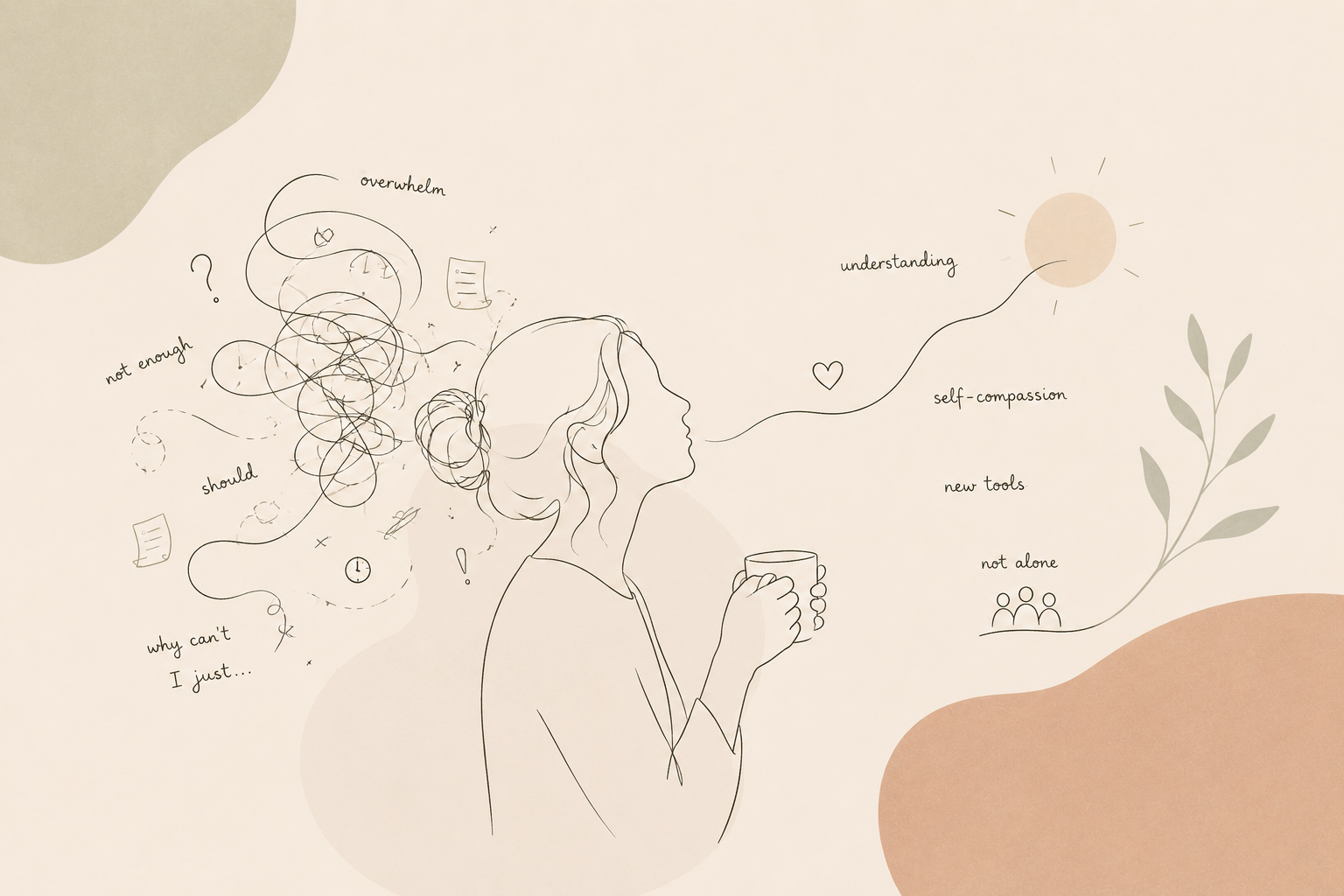
late diagnosed ADHD woman overwhelm to understanding illustration beneath the pattern therapy maryland

Why ADHD in Women Can Go Unrecognized

Many women with ADHD never fit the stereotype people expect, because the version of ADHD most people were taught to recognize was never really built around them.

You may have been the student who got good grades, stayed quiet in class, and appeared responsible on the outside. But beneath that image was often an exhausting amount of overcompensating: staying up later than everyone else to finish assignments, relying on urgency to get things done, overpreparing out of fear of failure, and silently carrying the overwhelm of trying to keep everything together.

A lot of women with ADHD learned how to compensate before they ever realized they were compensating. Maybe you became the reliable one. The organized one. The high achiever. The one who always figured it out somehow. What people often did not see was how much pressure, urgency, perfectionism, and constant internal criticism were happening underneath that image just to keep everything functioning.

Over time, the mask can become so normalized that even you may not realize how much you are struggling underneath it. If you were getting good grades, showing up for other people, or meeting expectations on the outside, there may not have been much room for anyone to recognize what was happening internally.

Instead, the overwhelm often gets interpreted as anxiety, emotional sensitivity, disorganization, or a need to simply “try harder.” For many women, ADHD is not missed because the symptoms are absent. It is missed because the symptoms are hidden underneath years of coping, masking, and overcompensating.


What It Actually Looks Like on the Inside

From the outside, it can seem like things are fine. You are still showing up, still getting things done, and keeping enough moving that nobody around you would necessarily know something feels off. But underneath that, there is often a level of mental noise that does not really quiet down. Even when you are trying hard, even when you are doing your best, life can still feel like it requires more effort than it seems to for the people around you. Not because you are doing anything wrong. Just because your brain is working harder than anyone can see.

Something that does not get talked about enough is how exhausting it is to just hold everything in your head at once. When everything feels equally urgent, figuring out where to even start can become its own kind of overwhelm. An unanswered text, an email sitting in your inbox, a form you have been meaning to fill out, a phone call you keep putting off. The longer something sits there unaddressed, the heavier it tends to get. What might look like avoidance from the outside is often something closer to a system that has become so overloaded it does not know where to begin.

Not because you do not care. Often you are thinking about it more than anyone realizes. But caring about something and being able to start it are two completely different things when your nervous system is already at capacity. Over time, that becomes its own cycle. The overwhelm makes it harder to start, not starting creates shame, and the shame makes the whole thing feel even bigger than it already was.

There is also a kind of exhaustion that comes with ADHD that does not always show up in obvious ways. Not the kind of tired that sleep fixes, but the kind that builds from years of working twice as hard just to appear like everyone else. Monitoring yourself constantly. Managing what shows and what does not. After a while that wears on you in ways that are hard to explain and even harder to recover from.

One of the more painful parts of all of this is that the inconsistency makes it hard to give yourself any grace. Because you have seen what you are capable of. You have been focused before. Productive, creative, completely on top of things. That version of you is real and you know it. Which is exactly why it hurts so much when you cannot find her. The shame around ADHD inconsistency is often not about a lack of ability. It is about knowing what you can do and not being able to predict when you will be able to do it. That gap is where a lot of the self-doubt quietly takes root.


When the Struggle Becomes a Story About Who You Are

At some point, the struggle stops feeling like something that's happening to you and starts feeling like something that's wrong with you. It's a slow shift. It doesn't happen all at once. And after enough of those moments, something shifts. The struggle stops feeling like a hard season and starts feeling like a personality flaw.

For a lot of women with ADHD, what it settles into is some version of being both too much and not enough at the same time. Too emotional. Too sensitive. Too reactive. And somehow still not pulling it together the way everyone else seems to. Both things feeling true at once is part of what makes it so disorienting. Because they feel like they cancel each other out, but they don't. They just both feel true.

What makes these beliefs stick is that they're not built on nothing. Someone probably told you at some point that you had so much potential. And you held onto that. But potential is a strange thing to carry when you're watching yourself struggle with things that seem to cost other people nothing. You showed up fully sometimes. Other times you couldn't, and you never quite understood why. Your feelings got called too much. What was underneath them rarely got asked about. After a while, it stops feeling like you're someone who struggles with certain things and starts feeling like you're just someone who can't get it together.

And eventually you don't even need anyone else to tell you that. So you start doing it to yourself. This time will be different. You set the reminder, make the list, mean it completely. And then it happens again anyway. And the story you tell yourself isn't that the approach wasn't working. It's that you are the problem.

A lot of the things people tend to praise in women with ADHD are quietly rooted in this. Perfectionism is gap-closing. Getting there before anyone else can point it out. Overexplaining is what years of being misread does to a person. The overexplaining isn't defensiveness. It's what happens when you've been misread enough times that you start trying to get ahead of it. The constant apologizing, the not asking for help, the becoming the person who holds everything together for everyone else so that nobody's looking too closely at what you might be dropping. These aren't personality traits. They're what coping looks like when it's been going on long enough to feel normal.

And over time, the shame gets so woven into how you see yourself that it stops feeling like a reaction to hard experiences. It just feels like the truth about who you are. And that's the part that's hardest to talk someone out of. Not because it's accurate. But because it's been the operating assumption for so long that questioning it feels like the strange thing to do.


The Grief of Late-Diagnosed ADHD

A late ADHD diagnosis is often talked about as a moment of relief. And it can be. Finally having language for something you have spent years trying to explain to yourself, and never quite finding the words for, does something. It's clarifying in a way that's hard to describe.

But relief isn't usually the only thing that shows up.

Sometimes what comes alongside it is grief. Not instead of the relief. At the same time. And going back and forth between both of those things, feeling confused, overwhelmed, and frustrated, sometimes all in the same hour, is more normal than most people talk about.

You may suddenly realize how long you spent blaming yourself for something that had a name the whole time. And once that lands, it changes how you look at a lot of what came before it.

The friendships that didn't survive because you seemed “unreliable”. The relationships where you were told that you “didn't care enough”. The jobs that were harder to hold onto than they should have been. The years you spent convinced you were lazy, dramatic, irresponsible, or just wired wrong somehow. The younger version of you who kept trying harder without ever understanding why it wasn't working.

And that's a lot to sit with.

For a lot of women, the grief is specifically about how invisible it all was. You were surviving underneath the appearance of functioning, and nobody around you fully saw what that was costing. You were probably even praised for holding it together. You may have spent years in therapy working on things that were real, but that never quite got to the root of what was actually going on. And at some point, you might find yourself sitting with a question that's hard to shake: What could have been different if someone had seen it sooner? What relationships might have survived? What opportunities might not have slipped? What would it have felt like to move through the world with the right support, instead of quietly building coping strategies for something nobody had named or noticed in you yet?

That's not self-pity. It's just an honest thing to sit with.

Part of healing is being allowed to acknowledge that things could have been different. That the younger version of you deserved more context than she got. That it would have been okay to need more support than you were given. You're allowed to feel something about that, even while you're also grateful to finally have answers.

The grief of a late diagnosis isn't a sign that you're stuck or that you're not doing the work. It's what happens when one piece of information changes the meaning of your entire history. That's not small. And it doesn't have to be rushed through.


The Reframe

Understanding yourself later in life does not erase the hard years. It does not suddenly make the burnout disappear or undo the grief that can come with realizing how long you spent blaming yourself for something you never had the right language for. But it can start to change what those years mean.

The struggle was real. And it finally has context.

A lot of women with late-diagnosed ADHD spent years seeing themselves through the lens of failure. Not trying hard enough. Not being disciplined enough. Not being consistent enough. But when the context changes, the story can start to change too. Maybe those years were not proof that you were lazy or broken. Maybe they were years of surviving something difficult without the support, understanding, or tools you actually needed.

And sometimes that shift changes the way you look at the younger version of yourself, too. The version of you who kept trying harder. Who kept making promises to herself and meaning them. Who kept wondering why things that looked manageable for other people seemed to cost her so much. You may start to see her with more understanding than criticism. Not as someone who failed, but as someone who was doing the best she could with information she did not yet have.

The things you developed to survive may start to make more sense too. The perfectionism. The overexplaining. The caretaking. The constant apologizing. None of those things came out of nowhere. They were ways of adapting to an experience that felt confusing, overwhelming, and emotionally expensive for a very long time. That does not mean all of those patterns still serve you. But understanding where they came from can soften the way you relate to them.

And slowly, the self-criticism can start to lose some of its authority. Not all at once. Not overnight. But enough to create a little more space between what happens and what you make it mean about who you are. Enough to start questioning whether shame deserves to be the voice that explains you to yourself anymore.


When The Struggle Finally Has Language

There is a different kind of relief that can come from finally understanding yourself more clearly. Not because everything suddenly gets easier, and not because the hard years disappear, but because the story starts making more sense. You are not forcing yourself to keep interpreting every struggle as a personal failure anymore.

And sometimes healing starts there. Not with fixing everything immediately, but with finally having somewhere to put all of it. The grief. The anger. The confusion. The exhaustion of carrying something for years without fully understanding what it was. Being able to talk about that honestly, without feeling rushed through it or needing to make it sound smaller than it actually was, can matter more than people realize.

A lot of women with late-diagnosed ADHD also realize how little they trust themselves anymore. After enough missed deadlines, forgotten things, overwhelm, shutdown, and self-criticism, self-trust starts to erode quietly. You stop believing your own intentions. You stop fully believing yourself when you say, “This time I'll stay on top of it.” Part of healing is not becoming a completely different person. It's slowly rebuilding a relationship with yourself that is not rooted entirely in shame.

And maybe one of the hardest parts of carrying all of this for so long was how alone it felt. So much of the struggle happened internally. Other people saw the functioning version. The coping version. The version that kept finding a way to make it work somehow. They usually did not see what it was costing you underneath that.

Learn more about how I approach ADHD Therapy here.


Read More